Today, businesses are finding smarter ways to use digital technologies to stay on top of operations and connect with customers. With smart online platforms, managing data and everyday tasks is easier and more efficient than ever. Companies are also using digital intelligent marketing tools to reach the right people at the right time, while AI-powered promotional systems make campaigns feel personal and track results automatically. On the financial side, automated finance-management systems help businesses make faster, smarter decisions with fewer errors.
When you combine all of this with automated call center software, customer support stops being just a routine task—it becomes an experience that feels seamless and personal. Thanks to voicebot AI and AI-driven efficiency in customer service, every call or interaction is faster, smoother, and genuinely helpful, turning your support team into a true growth driver rather than just a cost center.
What Is Automated Call Center Software?
Automated call center softwareis a platform that uses technology to handle and assist with inbound and outbound phone calls. It automates routine tasks, helps agents work more efficiently, and often uses AI to understand intent, route calls, and suggest answers.
Instead of relying solely on human agents to pick up every call, this type of software combines tools such as IVR, call routing, dialers, and analytics to make sure each caller gets the right help, at the right time, with minimal friction.
Core Goals of Automated Call Center Software
- Reduce wait times and abandoned calls.
- Route customers to the right person or self-service option instantly.
- Automate repetitive, low‑value conversations so agents can focus on complex cases.
- Boost first call resolution and customer satisfaction.
- Give leaders real‑time visibility into performance.
Top 10 Automated Call Center Software Solutions
- Bright Pattern
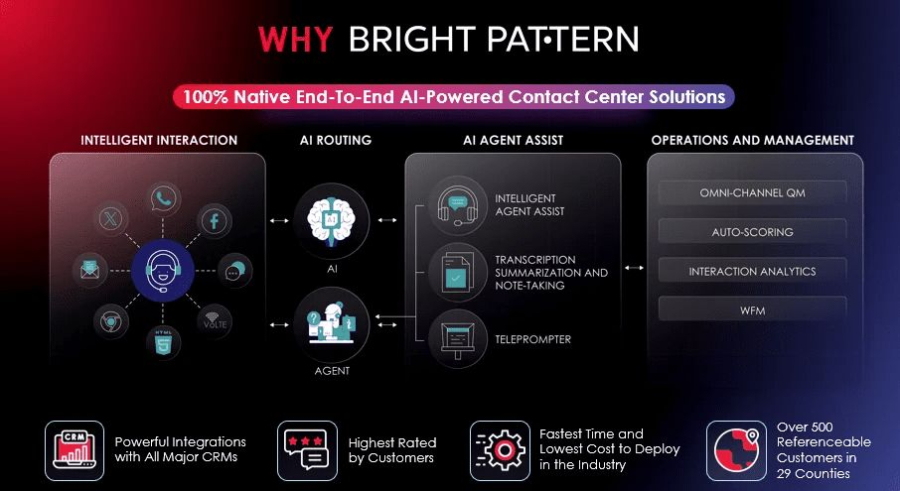
Bright Pattern is a leading automated call center software that combines voicebot AI and AI-driven efficiency in customer service to deliver exceptional customer experiences. Its cloud-based platform allows businesses to handle more calls, resolve issues faster, and maintain consistency across channels like phone, chat, SMS, and social media. With advanced analytics, intelligent routing, and seamless integration with CRMs, Bright Pattern helps organizations reduce operational costs while boosting customer satisfaction. It also offers easy-to-use tools for supervisors to monitor performance in real time, making it ideal for companies that want to turn their contact center into a strategic growth engine rather than just a cost center.
- Five9
A cloud-based contact center solution with AI-powered automation, IVR, and analytics to improve customer interactions and agent productivity.
- Genesys Cloud CX
Offers a robust AI-driven platform for omnichannel engagement, workforce optimization, and predictive routing, helping businesses deliver personalized customer experiences.
- Talkdesk
Combines cloud contact center software with AI features to streamline workflows, enhance agent efficiency, and boost customer satisfaction.
- NICE inContact
Delivers AI-powered call routing, automation, and analytics for scalable and efficient omnichannel customer support.
- Cisco Contact Center
Integrates advanced telephony with AI tools to optimize call handling, provide real-time insights, and improve overall contact center performance.
- 8x8 Contact Center
Cloud-based solution with automated workflows, AI chatbots, and detailed reporting tools to help businesses manage customer interactions more effectively.
- Zendesk Talk
Simplifies voice-based customer service with AI-driven support, CRM integration, and analytics for actionable insights.
- RingCentral Contact Center
Provides AI-enhanced cloud contact center software with multichannel support, workflow automation, and real-time analytics.
- Freshcaller by Freshworks
Offers an easy-to-use cloud call center platform with AI features, call routing, and reporting tools designed for small to medium-sized businesses.
How Automated Call Centers Work
Behind the scenes, automated call center software orchestrates several technologies to streamline every interaction. While implementations vary, most modern solutions follow a similar flow:
- Call initiation– A customer dials your number or your team places an outbound call.
- Initial handling– An auto‑attendant or IVR greets the caller and offers menu options, speech recognition, or simple self‑service.
- Routing logic– Based on the caller's input, phone number, language, or previous history, the system decides whether to route to an agent, a queue, voicemail, or another automated workflow.
- Agent assist and automation– If the call reaches an agent, the software provides screen pops, customer context, scripts, and AI suggestions to speed up resolution.
- Wrap‑up and reporting– After the call, outcomes are logged, metrics are updated, and recordings or transcripts are stored for quality and training.
Key Technologies Under the Hood
- Interactive Voice Response (IVR)– Menu prompts that allow callers to self‑serve or route themselves through keypad input or speech.
- Automatic Call Distribution (ACD)– Logic that distributes calls to the best available agent or queue.
- AI and Natural Language Processing (NLP)– Understands caller intent, powers virtual agents, and suggests agent responses.
- Cloud infrastructure– Delivers flexible, scalable call handling without heavy on‑premises hardware.
- Integrations– Connects with CRM, help desk, and other tools so all customer data is in one place.
Essential Features of Automated Call Center Software
Not all platforms are created equal. The most impactful solutions share a set of powerful, automation‑driven features that directly improve customer and agent experiences.
1. Intelligent Call Routing
Intelligent routing goes beyond simple round‑robin distribution. It maps each call to the best destination using rules such as:
- Customer type (VIP, new prospect, existing client).
- Agent skills and languages.
- Business hours and time zones.
- Current queue lengths and wait times.
- Caller history and open tickets.
This means high‑value customers reach your most skilled agents, and callers are less likely to be bounced between departments.
2. Advanced IVR and Self‑Service
A modern IVR does much more than say "Press 1 for sales". With the right configuration, it can handle a significant portion of routine calls end to end. Examples include:
- Checking order or shipment status.
- Confirming, rescheduling, or canceling appointments.
- Processing simple payments or account updates.
- Answering FAQs and providing recorded information.
The benefit is twofold: customers get instant answers 24/7, and your team handles fewer repetitive calls.
3. Virtual Agents and Voice Bots
AI‑powered virtual agents can converse with callers in natural language. They listen, understand intent, and respond with helpful information or actions. Common uses include:
- After‑hours support for common issues.
- Automated lead qualification and call triage.
- Proactive outbound reminders and notifications.
When the virtual agent reaches its limits, it smoothly hands off to a human, passing along context so the caller does not need to repeat themselves.
4. Outbound Dialers and Campaign Automation
For sales teams, collections, renewals, and customer outreach, automated dialers are invaluable. They can:
- Call through lists automatically, connecting agents only when a human answers.
- Schedule follow‑ups and callbacks based on customer preferences.
- Automate reminders for appointments, policy renewals, or subscription expirations.
This dramatically increases talk time and reduces the manual effort of dialing and leaving repeated voicemails.
5. Omnichannel Support and Context
Many automated call center platforms also connect with email, chat, and messaging channels. The main advantage isshared contextso that when a customer calls after chatting or emailing, the agent sees the full history and can respond intelligently.
6. Real‑Time Analytics and Dashboards
Clear, real‑time visibility turns your call center into a data‑driven operation. Useful metrics include:
- Current queue sizes and average wait times.
- Service level (for example, percentage of calls answered within 20 seconds).
- Call volumes by hour, day, and campaign.
- Agent occupancy, handle time, and availability.
Leaders can spot issues quickly and make data‑backed staffing, training, and process decisions.
7. Call Recording, Quality, and Compliance Tools
Automated recording and evaluation tools help your team steadily improve. Common capabilities include:
- Recording calls for training and quality review.
- Transcribing conversations for faster analysis.
- Flagging keywords or phrases for compliance monitoring.
- Scorecards and coaching workflows to support agents.
Business Benefits of Automated Call Center Software
The right solution delivers tangible benefits across your organization, from operations and finance to sales, marketing, and customer success.
1. Lower Operating Costs
Automation helps your team handle a higher volume of calls without proportional increases in staff. Cost savings come from several areas:
- Self‑servicedeflects routine inquiries from agents.
- Efficient routingreduces time spent transferring calls.
- Shorter handle timesmean agents can help more customers per shift.
- Cloud‑based deploymentminimizes hardware and maintenance costs.
Over time, these efficiencies add up to a leaner, more scalable operation.
2. Better Customer Experience
Customers judge your brand by every interaction. Automated call center software creates a consistent, high‑quality experience by:
- Answering quickly, even during peak periods.
- Routing callers to the right place without multiple transfers.
- Offering 24/7 self‑service for simple needs.
- Providing personalized greetings and options based on caller data.
The result is less frustration, more loyalty, and more positive word of mouth.
3. Higher Agent Productivity and Satisfaction
When repetitive tasks are automated, agents can focus on work that actually requires human judgment and empathy. This leads to:
- Reduced burnout and turnover.
- More engaging, value‑adding conversations.
- Clearer goals and performance feedback through analytics.
- More time for consultative selling or complex problem‑solving.
Happier agents almost always translate into happier customers.
4. Increased Revenue and Conversion
Automated call center software is a revenue driver, not just a cost saver. It can help you:
- Capture more inbound leads without missed calls.
- Run more outbound campaigns in less time.
- Upsell and cross‑sell more effectively with timely prompts and data.
- Recover potential churn with proactive outreach workflows.
By ensuring that every qualified lead gets fast, relevant attention, your close rates and average order values can steadily improve.
5. Clear, Actionable Insights
Because automated systems log every interaction, you gain a rich source of customer insight. You can analyze:
- Top reasons for calls and recurring issues.
- Customer sentiment trends across time.
- Performance differences between scripts, campaigns, or teams.
These insights feed back into product decisions, marketing messaging, and service improvements for a powerful continuous improvement loop.
Common Use Cases and Success Scenarios
Automated call center software is versatile enough to support many different business models and departments. Here are some common, high‑impact scenarios.
Customer Support and Service Desks
Support teams use automation to:
- Handle password resets, order tracking, and basic troubleshooting via IVR or virtual agents.
- Route complex cases directly to specialized agents with the right skills.
- Collect post‑call surveys automatically to track satisfaction.
This creates a responsive support experience without overwhelming your team.
Sales and Outbound Campaigns
Sales organizations benefit from:
- Automated dialing for cold outreach and warm lead follow‑ups.
- Prioritization rules that surface the hottest leads first.
- Script guidance and call recordings for continuous optimization.
More time spent talking to the right prospects translates directly into more closed deals.
Appointment‑Driven Businesses
Healthcare providers, service professionals, and appointment‑based businesses use automation to:
- Send automated appointment reminders and confirmation calls.
- Allow patients or customers to confirm, reschedule, or cancel without an agent.
- Reduce no‑shows and fill open time slots more efficiently.
Billing, Collections, and Renewals
Finance and subscription teams rely on automated call center tools to:
- Reach customers with past‑due accounts at scale.
- Offer simple, self‑service payment options by phone.
- Proactively call customers approaching renewal dates.
With structured workflows, these sensitive conversations become more consistent, compliant, and effective.
Key Metrics and KPIs to Track
To get the most from your automated call center software, track a focused set of metrics that reflect both efficiency and experience.
|
Metric |
What It Shows |
Why It Matters |
|
Average Speed of Answer (ASA) |
How quickly calls are answered. |
Directly impacts customer satisfaction and abandonment. |
|
First Call Resolution (FCR) |
Percentage of issues resolved on first contact. |
Higher FCR means smoother experiences and lower costs. |
|
Call Abandonment Rate |
Share of callers who hang up before reaching an agent. |
Highlights capacity, IVR, or wait time issues. |
|
Average Handle Time (AHT) |
Average duration of calls including wrap‑up. |
Reveals efficiency and coaching opportunities. |
|
Self‑Service Containment |
Percentage of interactions fully resolved by IVR/AI. |
Measures the real impact of automation on volume and cost. |
|
Customer Satisfaction (CSAT) |
Customer‑rated score after interactions. |
Shows how customers feel about your service. |
How to Choose the Right Automated Call Center Software
Selecting a platform is a strategic decision. The best solution is the one that fits your goals, size, and customer journey. Consider these dimensions during your evaluation.
1. Your Primary Objectives
Clarify what you want to achieve first. For example:
- Reduce wait times and abandoned calls.
- Scale outbound sales efforts.
- Extend support coverage outside business hours.
- Improve analytics and quality management.
Your top goals should guide must‑have features and your implementation roadmap.
2. Feature Depth vs. Ease of Use
Consider who will configure and manage the system. Look for:
- Intuitive interfaces for building IVR flows and routing rules.
- No‑code or low‑code tools to reduce reliance on IT.
- Clear documentation and in‑product guidance.
A solution that is simple to maintain will deliver value faster and keep improving over time.
3. Integrations with Existing Tools
To unlock full value, your call center software should connect smoothly with tools such as:
- Customer Relationship Management (CRM) systems.
- Help desk or ticketing platforms.
- Marketing automation and sales engagement tools.
- Billing or practice management systems.
Integrated data means less manual work and richer customer context during every call.
4. Scalability and Reliability
Evaluate how well the platform can grow with you. Key points include:
- Support for spikes in call volume during promotions or emergencies.
- Geographic coverage and call quality across regions you serve.
- Redundancy and uptime commitments.
5. Security and Compliance
Call centers handle sensitive information. Confirm that the solution supports:
- Secure call recording and storage practices.
- Role‑based access controls for agents and admins.
- Industry‑specific requirements where relevant, such as financial or healthcare standards.
Strong security practices protect both your customers and your brand.
Implementation Best Practices for Fast Wins
Rolling out automated call center software does not need to be overwhelming. A thoughtful, phased approach maximizes early wins and long‑term success.
1. Start with High‑Impact, Low‑Complexity Workflows
Begin with a handful of clear, high‑volume use cases, such as:
- Simple IVR menus for routing and basic FAQs.
- Appointment reminders and confirmations.
- Order status checks integrated with existing systems.
These quick wins build confidence and demonstrate value to stakeholders.
2. Involve Agents Early
Agents understand customer pain points better than anyone. Include them in:
- Designing IVR menus and scripts.
- Testing virtual agent responses.
- Suggesting automation opportunities based on repetitive calls.
When agents feel heard and supported, adoption and performance improve dramatically.
3. Pilot, Measure, and Iterate
Before rolling out changes across your entire operation, run controlled pilots:
- Test new call flows with a subset of customers or lines.
- Measure the impact on key KPIs like wait time and FCR.
- Refine prompts, routing logic, and scripts based on real data.
This approach reduces risk and continually sharpens your customer experience.
4. Train and Coach Continuously
Automation does not replace agent development; it amplifies it. Use analytics and call recordings to:
- Spot common sticking points and objection patterns.
- Highlight top performers and replicate their techniques.
- Update scripts, prompts, and knowledge bases regularly.
The Future of Automated Call Centers
Automation in call centers is rapidly evolving. While current systems already deliver major gains, the next wave of innovation promises even more.
More Natural Conversations with AI
Advances in speech recognition and language models are making virtual agents more conversational, empathetic, and context‑aware. Over time, they will handle increasingly complex interactions while still escalating sensitive or high‑value conversations to humans.
Deeper Personalization
Future systems will leverage more customer data across devices and channels to tailor every interaction. Callers will experience:
- Personalized greetings and offers.
- Context‑aware self‑service based on recent activity.
- Proactive outreach that solves issues before customers call.
Tighter Alignment with the Entire Customer Journey
Call centers will become even more closely integrated with marketing, product, and customer success. Insights from conversations will continuously shape campaigns, messaging, and features, creating a powerful feedback loop from the front lines to strategic decision‑making.
Conclusion: Turning Your Call Center into a Strategic Advantage
Automated call center software lets you do more than just answer the phone. It gives you a scalable, data‑driven engine for customer engagement, loyalty, and growth. By combining intelligent routing, self‑service, AI‑powered assistance, and rich analytics, you create a support and sales experience that is fast, reliable, and consistently on brand.
When you choose the right platform, focus on high‑impact workflows, and keep iterating based on real‑world data, your call center shifts from a reactive cost center into a proactive, revenue‑generating asset that supports your entire customer journey.
